Afbeelding
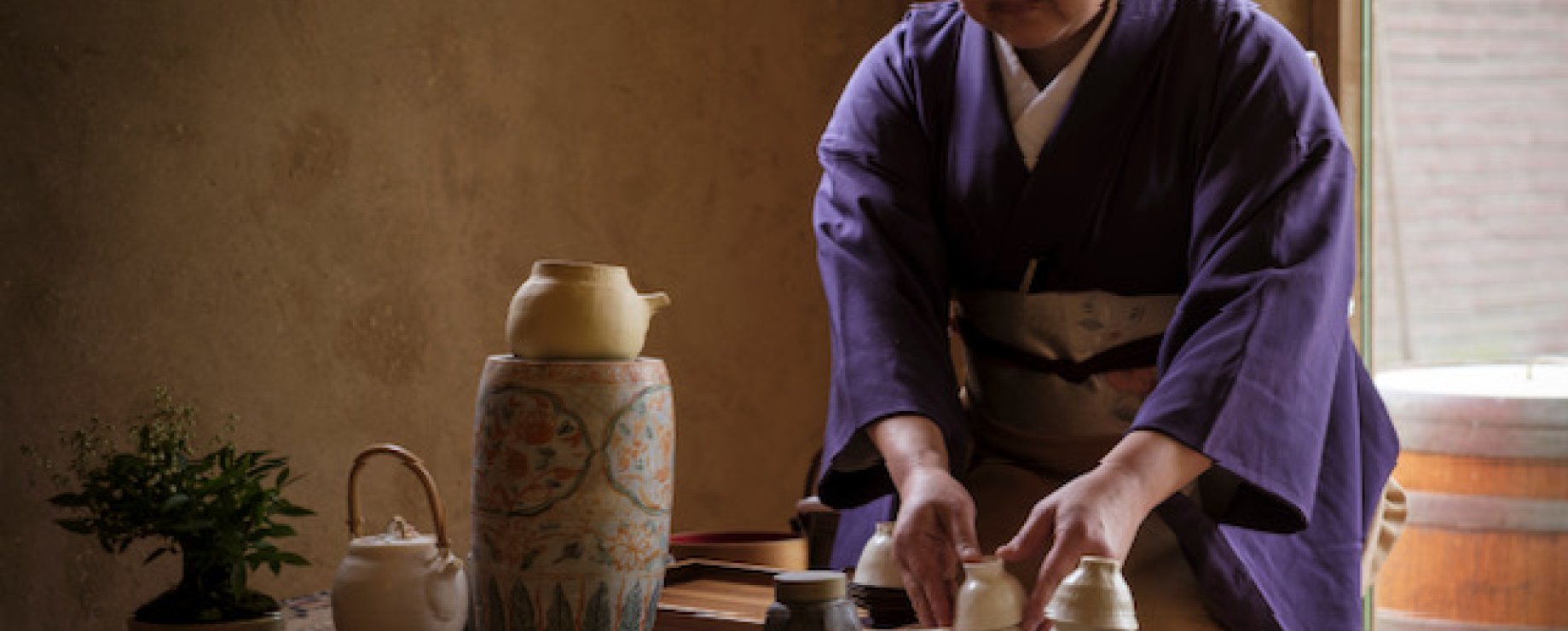


In this article, Roxanna Maas interviews Netherlands-based tea master and ceramics artist Matsuo Haruka about her practice.
Matsuo Haruka and Kigata Banko-yaki
Matsuo Haruka is the ninth-generation successor to the Kigata Banko-yaki technique and a tea master of the Ōbaku Baisa-ryū sencha tea ceremony. She holds degrees from the Kyoto City University of Arts and the Gerrit Rietveld Academy and currently lives and works in the Netherlands. Haruka was born in Tokyo and grew up in Mie Prefecture, a place famous for its authentic craft production, including ceramics, Matsusaka cotton and Ise katagami lanterns, as well as the famous pilgrimage shrine located in the city of Ise. There, Haruka met her Kigata Banko-yaki sensei, Seigetsu Iriyama (1922–2014), through her father, himself an artist who valued craft production. She was immediately captivated by Iriyama’s concentration and use of tools as he produced his teapots, likening his focus to a pilot in his spaceshuttle. He always welcomed his visitors with a cup of tea, connecting with them through his craft. At first, Iriyama did not want to take on an apprentice, but Haruka was adamant about learning the technique from him. After repeatedly asking that he become her sensei, he accepted her request, and she became his successor.
The Kigata Banko-yaki technique was invented in Mie Prefecture by Yusetsu Mori (1808–1882), who was inspired by the production of paper bamboo lanterns to construct a teapot with removable moulds. The technique involves pressing a flat slab of clay onto kakishibu paper, a natural paper made from the juice of persimmon fruit. The thin layer of clay is wrapped around the wooden construction to form the teapot. After the teapot is shaped, the wooden mould can be carefully dismantled and removed from the inside.

Image 1: Kigata Banko-yaki moulds.
Practising the Ōbaku Baisa-ryū sencha Tea Ceremony
The Kigata Banko-yaki technique has been closely associated with the Ōbaku Baisa-ryū sencha tea ceremony since its invention, as it allows the teapot's walls to be extremely thin, which is preferable for preparing green tea. Haruka’s ceremonies include gyokuro tea, a green tea that requires a lower water temperature and therefore doesn’t need thick-walled ceramics to retain heat. Originally, Haruka noticed that people were not interested in Kigata Banko-yaki and its connection to the Ōbaku Baisa-ryū sencha tea ceremony. Visitors often asked her to make larger tea pots that could hold as much tea as possible. This, however, is not how the technique was originally meant to be applied, as tea ceremonies always use small tea pots. She soon realised people did not know how to use the tiny teapot, inspiring her to study the Ōbaku Baisa-ryū sencha tea ceremony with tea master Sousen Nakai in order to host tea ceremonies herself and show how they can be used. Through hosting these ceremonies, she could communicate how the practice goes beyond the consumption of tea to embody its underlying philosophy. Haruka compares the understanding of the tea ceremony’s relation to her ceramics to learning how to drive a car: “If you only see the technique, it’s just a technique. You can see how you can drive a car, but it’s only once you drive a car yourself that you understand how your movements are connected to the vehicle.”
When she received the title of tea master, she asked her tea master, Sousen Nakai, how she could improve her practice. Her teacher suggested that the best way was to teach herself. Haruka has since taken on her own students to carry forward the tea ceremony tradition. As the tea ceremony is intrinsically rooted in Japanese culture, Haruka is highly aware that her living in the Netherlands shapes how she teaches her classes, even down to the different water composition. Therefore, she strives to teach her students as authentically as possible, which is why, for example, she has urged her students to take classes on how to wear kimono correctly. Through her efforts, she aims to keep the Ōbaku Baisa-ryū sencha tea ceremony alive, as in her words: “Even if you would change something by accident or by force, if you try to teach something as authentically connected to the culture as possible, the handling and its history won’t disappear.”
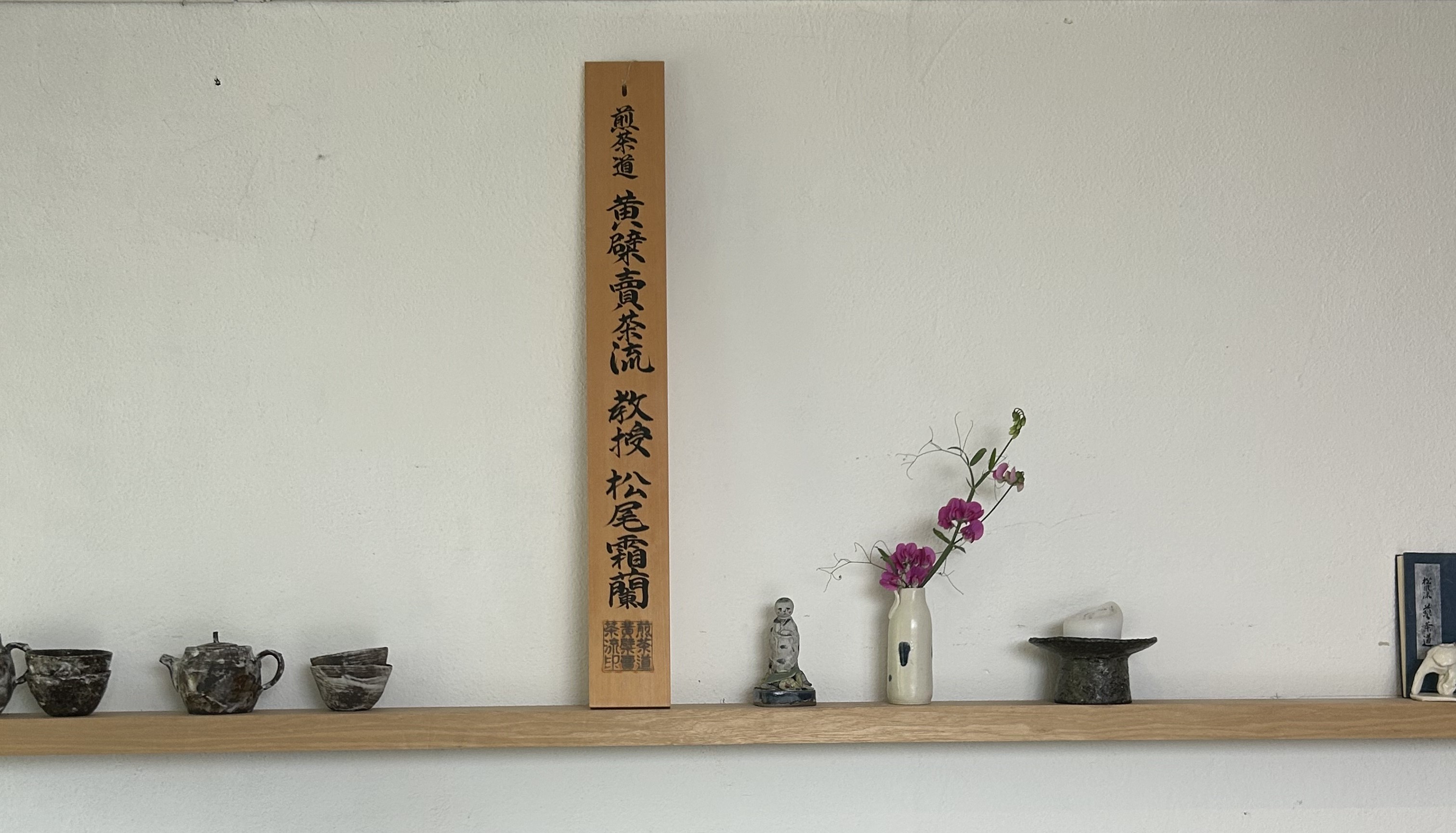
Image 2: Haruka's wooden teaching-license plaque from the Ōbaku Baisa-ryū school of sencha, shown here on a shelf alongside her ceramics.
Using Local Materials
When Haruka began her ceramic practice in the Netherlands, she initially used imported Japanese clay. Since this is officially prohibited, her family had to dry the clay completely to make it as compact as possible for shipping to the Netherlands. Using imported Japanese clay was not only impractical and expensive but also ecologically unsustainable, driving her to local clay instead. While the Kigata Banko-yaki technique itself remained unchanged, she had to apply a glaze to her pieces; Dutch clay is fired using oxidation, whereas traditional Japanese Banko-yaki uses a reduction firing method that functions without one. Haruka also embraces local materials in her glazes, for example, by making them with ashes from her friends’ fireplaces.
The first project she fully curated around the use of local materials was her The Way of Tea performance at the IJssel Biennale in 2021. She started by searching for clay in the cornfield where she would host her tea ceremony together with the farmer, who could locate the clay based on how the corn grew. Using the local clay, she crafted ceramics for the tea ceremonies and created a glaze using local wood ash from ‘t Gooi. Meanwhile, she also spread flower seeds in the exact spot where she sourced the clay and later incorporated the flowers into her tea ceremony. This resulted in an experience that was connected to that exact location in all of its separate elements, including the clay, the glaze and the tea itself – creating a circular process. After continuously preparing the tea ceremony in that spot, she sensed how the atmosphere of the place was transformed, as if entering a tea house.
This project served as an inspiration for her own tea house, Tea Tree, Tea Treaty, which she opened in May 2026. Similar to the IJssel Biennale, she notices how repeatedly hosting tea ceremonies in the space has transformed the atmosphere of the tea house. She collaborated with architect Barry van Waveren to connect the tea house to its locality in every aspect. The tea house is constructed with local clay from Drenthe and original components of the location where the tea house was built. Haruka built the tea house with the local community, including people with dementia, leaving their memories as part of the structure and connecting it to the circular process at the core of Haruka’s practice. By using local materials, instead of imported Japanese clay, Haruka has (perhaps surprisingly) felt closer to Japanese craft practices, since they have historically been developed around local materials and therefore cannot be separated from their locality. The circular process that marks Japanese crafts is recreated here by applying it to Dutch materials, and it is absent when using imported clay.
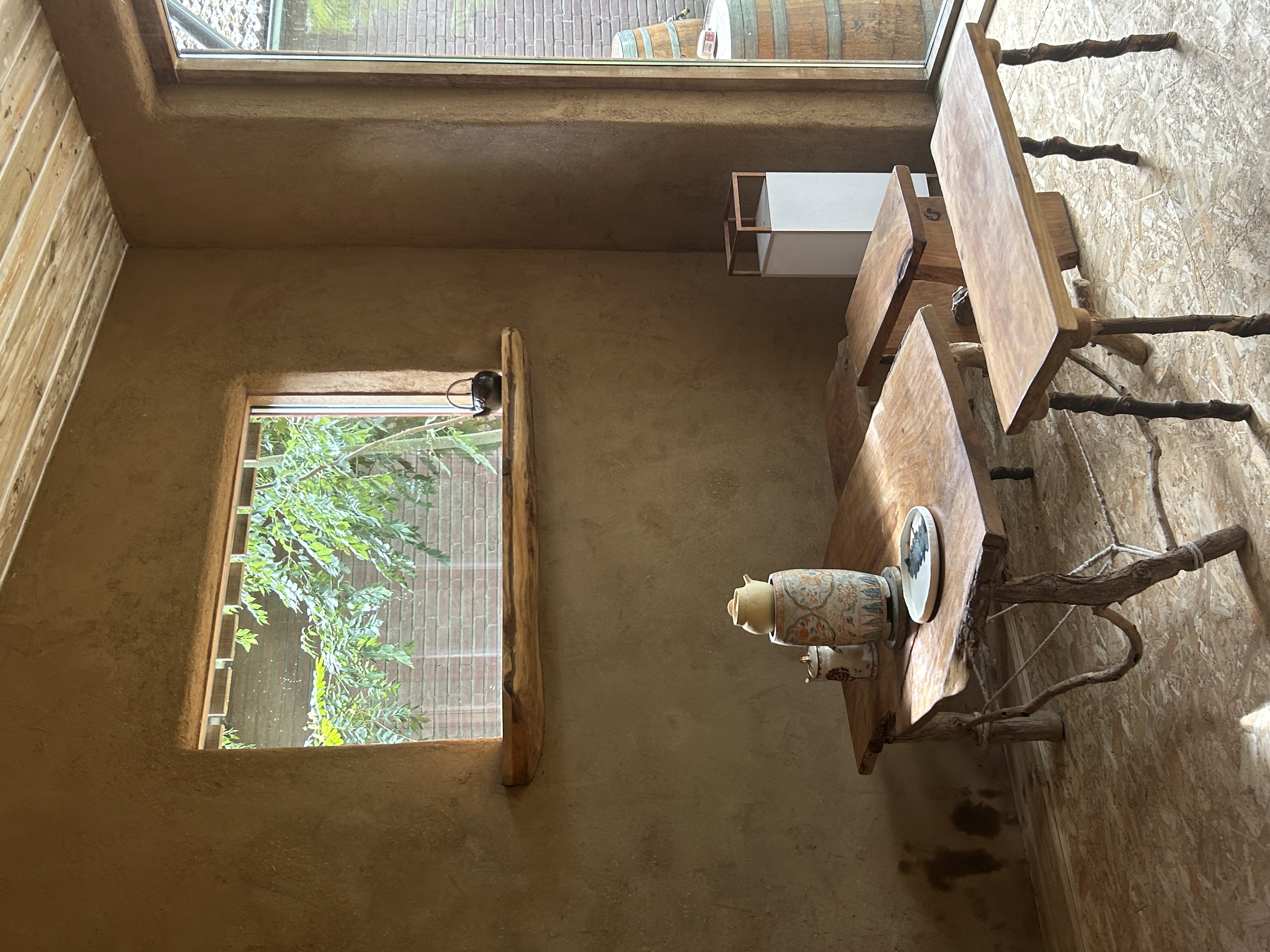
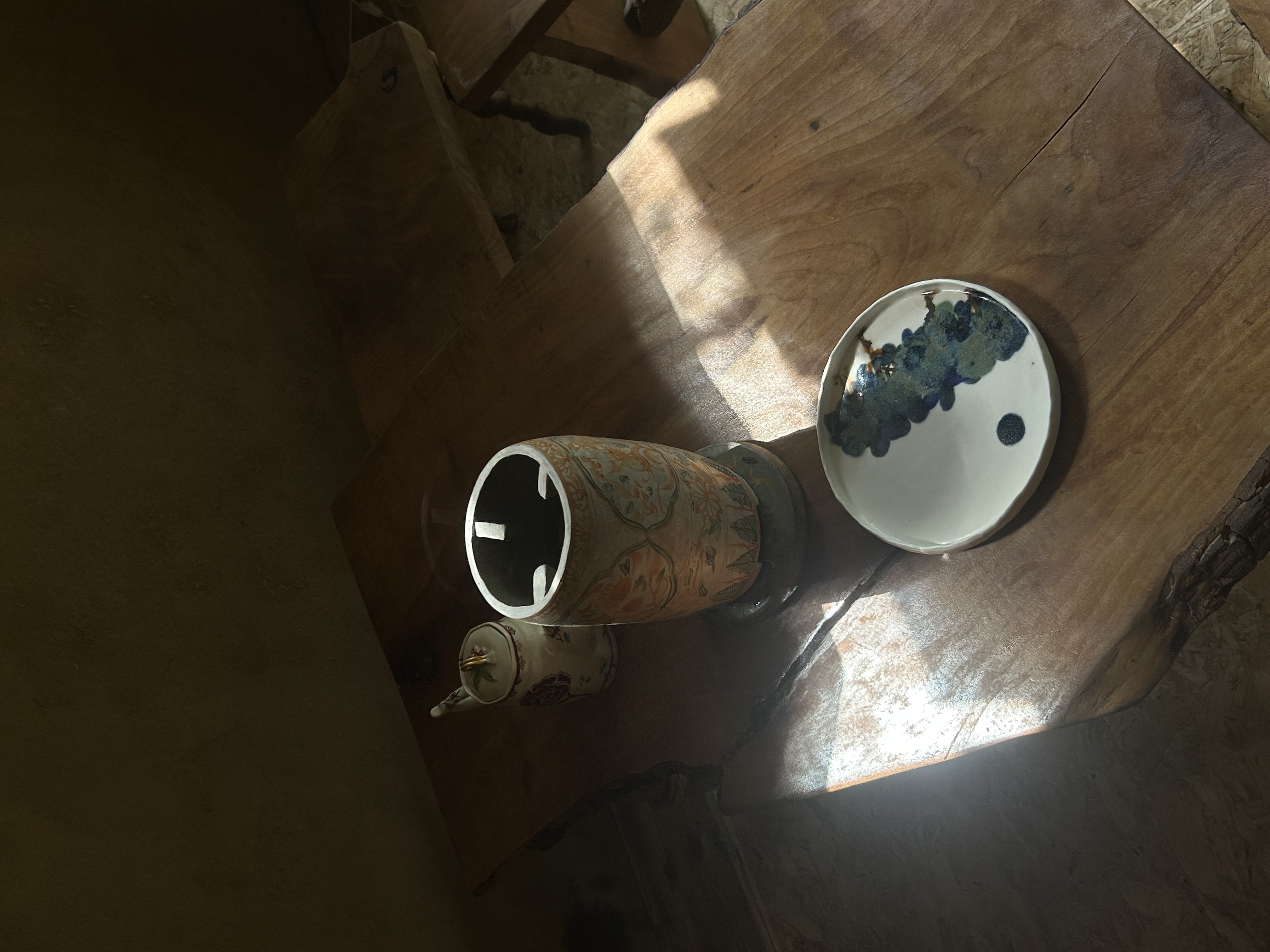
Image 3 and 4: Haruka’s tea house, Tea Tree, Tea Treaty.
The Buddhist Foundation
Haruka’s ceramics, tea ceremonies and attention to locality are interwoven with Buddhist philosophy. As she says: “Learning the tea ceremony is not only about preparing a cup of tea; the practice is deeply rooted in Buddhist philosophy.” Consequently, she finds her practice tied to the concept of mushin (無心), a Zen Buddhist term for the psychological state of “no mind” that allows for absolute presence, which also occurs during meditation. She experiences this sensation while hosting her tea ceremonies and crafting her ceramics. The Japanese philosopher and art critic Yanagi Sōetsu (1889-1961) also recognised this, which led him to develop the theory that the state of mushin is required to create high-quality crafts, like the ones found in Mie Prefecture. He named these folk crafts mingei (民芸) and established the Japan Folk Crafts Museum in 1936 in Tokyo to elevate their status to that of artistic objects, aiming to encourage people to find beauty in everyday objects.
Haruka’s father, a sculptor who had worked with Yanagi Sōetsu’s son, Sori Yanagi (1915-2011), recognised the importance of these folk crafts; this led him to introduce her to Iriyama, the master who would later become her sensei. Mingei objects are functional pieces created by craftspeople who rely on local materials and traditional methods, crafted in a state of mushin – an approach clearly reflected in Haruka’s work. Her ceramic art, tea ceremonies, focus on locality, and state of mushin all come together in Tea Tree, Tea Treaty, demonstrating that mingei is not merely an art-historical theory, but Haruka’s lived philosophy.
Current projects
Haruka currently teaches the art of the tea ceremony to her students, and one of them will be taking her tea master exam in Japan this year. The artist looks forward to accompanying her student in Japan, which will allow them to deepen their dialogues from their different cultural backgrounds. Lastly, Haruka approaches Tea Tree, Tea Treaty as a living project: the intangible atmosphere built up through repeated ceremonies has, in her words, gradually settled into the clay walls themselves. She plans to host tea ceremonies with her students that include teapots made from clay collected from the Naardermeer area, and plans to open these sessions to the local community around the tea house.
On September 26th, (prospective) youth members are invited to join us for a visit to Haruka’s ceramic studio. See this page for information on this event.
Further reading:
Yanagi, Soetsu. Mingei: Masterpieces of Japanese Folkcraft, 1991.
Ijsselbiënnale on Haruka’s website: click here.
Tea Tree, Tee Treaty on Haruka’s website: click here.